Dette er en favoritt i klubben og selv om det er overvekt av Pinot synes jeg alltid disse er overraskende friske og "eplete/chardonnay" i stilen. De første to i rekka var tydelig oksidative og spesielt 2000 årgangen var på grensen til premox og med hint av epleskrott og cider fra Hardanger. Steinaktig med litt mandarin og blir renere i uttrykket i glasset. Superdigg ! sa Øyvind og ga den 90 poeng ! Noen var høyere, men jeg tror ikke det var en optimal flaske. Eller så er det bare årgangen 2000....
Vi drakk 2000 årgangen også i vinmøte hos Jon i februar 2023:
Champagne Camille Saves Millèsime 2000
Litt mer struktur og fylde. 80% Pinot Noir/20% Chardonnay. Men denne har også noe oksidativt preg, moden åpen frukt med grapefrukttoner i finish. Ikke noen stor årgang i champagne og den virker litt sliten allerede. 89-90 poeng
2012 var endel smalere i uttrykket, også den startet også litt oksidativt, men rensket raskere opp i glasset. Gylden og god intensitet, slank, frisk og elegant. Men årgangen tar aldri helt av. 91 poeng
Igjen skilte årgangen 2008 seg ut. Mye mer energi, renere i utrykket, mer spenst og solid frukt. Årgangen er nok en av de beste siste 50 år i champagne. Syrlig snert samtidig som den har en veldig god fruktdybde. Appelsinzest, mineralsk og kompleks. Og kan fremdeles lagres i 20 år til ! 94 poeng.
Lys fersken på farge, moderat nese med innslag av grapefrukt i smak. Elegant med små lekre bobler. Overraskende lite autolysepreg, pen syre. Endel sødme, men åpenbart fruktsødme, dette er 0 dosage.
Trenger nok endel ytterligere lagring, er usikker. Kr. 700,- på VP. 88 poeng
Champagne Esprit Nature, Henri Giraud
Strågul med strøk av rosa. En mer klassisk champis i en PN/Chardonnay mix. Lett å like, god balanse med en fin modningstone. Veldig forskjellig stilmessig fra Marguet, men denne er mer tilgjengelig. Kr. 795,- på VP. Og er på Tax-Free`n på Gardermoen ! ....Som ikke er noe spesielt godt tegn ! 90 poeng.
Ren nese, slepne tanniner, en klassisk og tørr eldre bordeaux. Har fremdeles en god struktur og balanse. Ikke helt modne solbær og tørket potpurri av en mer jordlig aroma enn blomster. Mangler litt støttesødme som 1961 hadde. Men en særdeles elegant vin som viser den solide maskuliniteten slottet har. Drar på seg en syrlighet i glasset, men formatet er pent og meget vellykket. Men bør nok drikkes. Jeg sammenlignet det med engelsk herremann i tweed. Ultrakonservativ og litt stram i mimikken. Kunne like gjerne vært en Chateau Latour. De lager ikke slik vin lenger. 96 poeng
Broadbent: at best *****
Chateau Leoville Lascase 1961, St. Julien
En fremdeles mørk kjerne, den største forskjellen vs. 1945 var en rikere fremoverlent frukt og en fragrant og parfymert nese. Mer aromatisk med lær og klassiske strøk av sedertre og solbær. En god balansert vin, men ikke samme stamina som 1945. Holder seg ikke helt og blir litt bitter over tid og har ikke samme ryggraden som 45. Men wow, mye energi her fremdeles og vanskelig å skille de to. Og litt "star-struck" av mitt eget fødselsår. 95 poeng
Restaurant Panu 22. februar 2024 / Bejing Palace 14. oktober 2023;
"En vinsmaker som
ikke gjenkjenner den eksotiske cabernet sauvignon dominante karakteren i Chateau Mouton Rothschild, den svale og smidige elegansen i Chateau Lafite og den robuste
stoffligheten i Chateau Latour har er stykke å gå før han kan skryte på seg en detaljert kunnskap om Médoc"
Per Mæleng
Chateau Latour i Pauillac har et fantastisk rykte, ikke minst mht. sin holdbarhet. Legendariske årganger som 1959, 1961 og 1970 får fremdeles ofte panegyriske omtaler, men flaskene fra "off-årganger" imponerer like ofte med fast frukt og god tanninkvalitet. Slottet har en struktur som ingen andre slott og derfor skulle man kanskje tro at +80 år ikke er noe problem mht. lagring på langs. Men slik er det nødvendigvis ikke. 1934 og 1937 skal være de beste årgangene for rød Bordeaux på 30-tallet og dukker av og til opp på vinauksjoner nær deg. Til overkommelige priser. Begge flaskene her viste skjør frukt og vikende robusthet og ingen ytterligere lagring anbefales.
Chateau Latour 1934, Pauillac
Rødbrun svak kant, lær, moderat struktur, drar på seg en aroma av nype og blir volatil og flyktig på nesa. Vinen er moderat på alle måter, holder seg nogenlunde i glasset, men tørker etterhvert ut på finish. Mangler støttesødme og dybde. Drikk opp. 90 poeng
Broadbent: "At best *** and not getting any better. Curling like fallen leaves"
Chateau Latour 1937, Pauillac
Svakt parfymert og fragrant på nesa. Pen nese med innslag av tobakk og lær. Relativt klassisk inntil sursøte kirsebær og tørket frukt tar over i en baroloaktig stil. Holder seg 15 min og deretter drikk opp. 89 poeng
Årgangen 2021 er ikke en topp årgang i burgund, verken for hvit eller rød.
Vinteren var både mild og våt og det fortsatte med 25C+ i slutten av mars ! Etter tidlig og ivrig knoppskyting kom frosten 5. april med minus 6 minus ! Ikke lokal frost som i 2016, men generelt i hele området med snø 7. april. Det ble iverksatt massive tiltak bla. oppvarming med varmebluss, dette er et tiltak som flere nå ikke iverksetter både pga. sitt miljøengasjement, men også mht. kostnaden (betydelig mengder xtra arbeidstimer og ca. forbruk 2 tonn drivstoff pr. hektar pr dag !. Eksklusive produsenter som Comte Liger-Belair satte ut 800 varmebluss pr. hektar og på den måten hevet temperaturen rundt vinplantene fra minus 9C til +2C !) Flere beskjærer også nå vinplanten senere slik at det er mindre vinskudd når frosten kommer. Og flere produsenter legger "cover crops"/gress/høy mellom vinrankene for bedre frostbeskyttelse.
Frosten slo hardest til mot chardonnay som blomstrer tidligere. Flere vinmarker mistet 80 til 100% av druene, noe som medførte omfattende deklassifisering av Grand Cru materiell til 1cru og fra 1cru til kommunevin. Og det ble ikke bedre. Det kom mye regn om sommeren og betydelig innslag av meldugg. I 2020 var det 333 soltimer og i 2021 var det 210 soltimer, men pga frosten var det færre bær å levere sol til ! Vinhøsten ble nok reddet av en solrik periode i slutten av august og i begynnelsen av september. Tidvis regn ved en sen innhøsting 20. september gjorde ikke saken bedre, fordelen med mye dårlig frukt er at du må sortere xtra hardt når druene kommer i hus og flere produsenter i Beaune (rød) var relativt fornøyd med kvaliteten. Flere hadde for lite vin til å fylle opp tønnene (som er større i burgund enn i bordeaux), derfor ble det endel mix/deklassifisering - vinification intêgrale
Bruk av druestilk og helklasefermentering ble utfordrende dette året. Helklase og druestilk hjelper til med å fylle vintønnene samtidig som de reduserer syrenivå. Umoden stilk, som det var mye av dette året, resulterer i "grønne" viner så her måtte vinmakeren ta kloke valg.
Generelt gikk det tregt med alkoholfermenteringen og det var stor variasjon fra produsent til produsent hvor mye ekstraksjon/pigeage som var ønskelig. Som nevnt klarte man ikke å fylle opp store vintønner og flere brukte feuillettes (halvparten av 228 liter pieces) eller quarteaus (57 liter) Dette medførte dårligere temperaturkontroll og større innslag av eik enn ønskelig. Malo gikk sent, flere viner var ikke klare da de skulle bli tappet på flaske og det var viktig å lagre de en xtra vinter.
Tross alt dette; vinene fremstår relativt gode og vellykkede !
2021 er "back to normal", litt undermoden og grønn, klassisk og frisk i stilen. Transparent, lys, klar og som et motstykke til den mer konsentrerte, ekstraherte og mørke stilen i 2020. Det er stor variasjon både mht. produsent og områder.
De røde har livlig rødbærsfrukt som kan minne om tidligere kjølige årganger med snev av blodappelsin, tydelig mineralitet, små tanniner, lav alkohol og således veldig forskjellig fra den heftige stilen til 2019 og 2020. De er overraskende lite grønne til å ha fått så lite sol, men kan fremstå litt anemiske med for lite frukt. Vinene fremstår ikke i dag med et stort lagringspotensiale.
Teksten er basert på Vinous/Neil Martin
Viner drukket på Centropa BYO wines 10.januar 2024:
Chambolle Musigny 2021, Joseph Faiveley
Purpur mørk rød farge, fersk vin med endel tørrstoffer. Enklere vin med en ivrig og pen nese . Medium intensitet, snev av eik og noe grønt og umodent. Kan lagres. Men er den verdt kr. 775,- ? 89 poeng
Mercurey La Framboisière 2021, Domaine Faiveley
Lys og transparent i glasset med frisk og elegant rødbærsfrukt. Lett reduktiv, en viss antydning til kompleksitet, god mineralitet og en deilig lettdrikkelig vin. Jeg likte nok denne bedre enn de andre. Bra kjøp til kr. 455,- , men utsolgt og denne begynner å bli vanskelig å få tak i. 90 poeng
Pommard Les Rugiens 1cru 2021, Francois Gaunoux
Litt kokt i stilen med innslag av grønn Dent. Muted, reduktiv og denne viste seg virkelig ikke fram nå. Bør nok lagres mht. område og vinmark. 87 poeng inntil videre.
Nuits-Saint-George Les Herbues 2021, Pierre-Olivier Garcia
Lys ruby, tilbakeholden på nesa. Etterhvert i glasset; mye vin, parfymert og kompleks. Mangler ryggrad, men en sexy vin med sødmefulle bær i en pen kjølig stil. Spennende ny produsent (2016) som må sjekkes ut ! Vinmarken grenser til Vosne Romanèe. 92 poeng
Nuits-Saint-Georges Clos de la Marechale 2021, JF Mugnier
Mørk og solid vin. Rik og krydret med god kompleksitet. Drikker overraskende godt nå i en frempå og konsentrert stil. Lang ettersmak og en virkelig god Marechale. Vinmarken er blitt mye bedre (og dyrere !) de siste årene. Nok den siste årgangen < kr. 1 000,- på VP ! 93 poeng
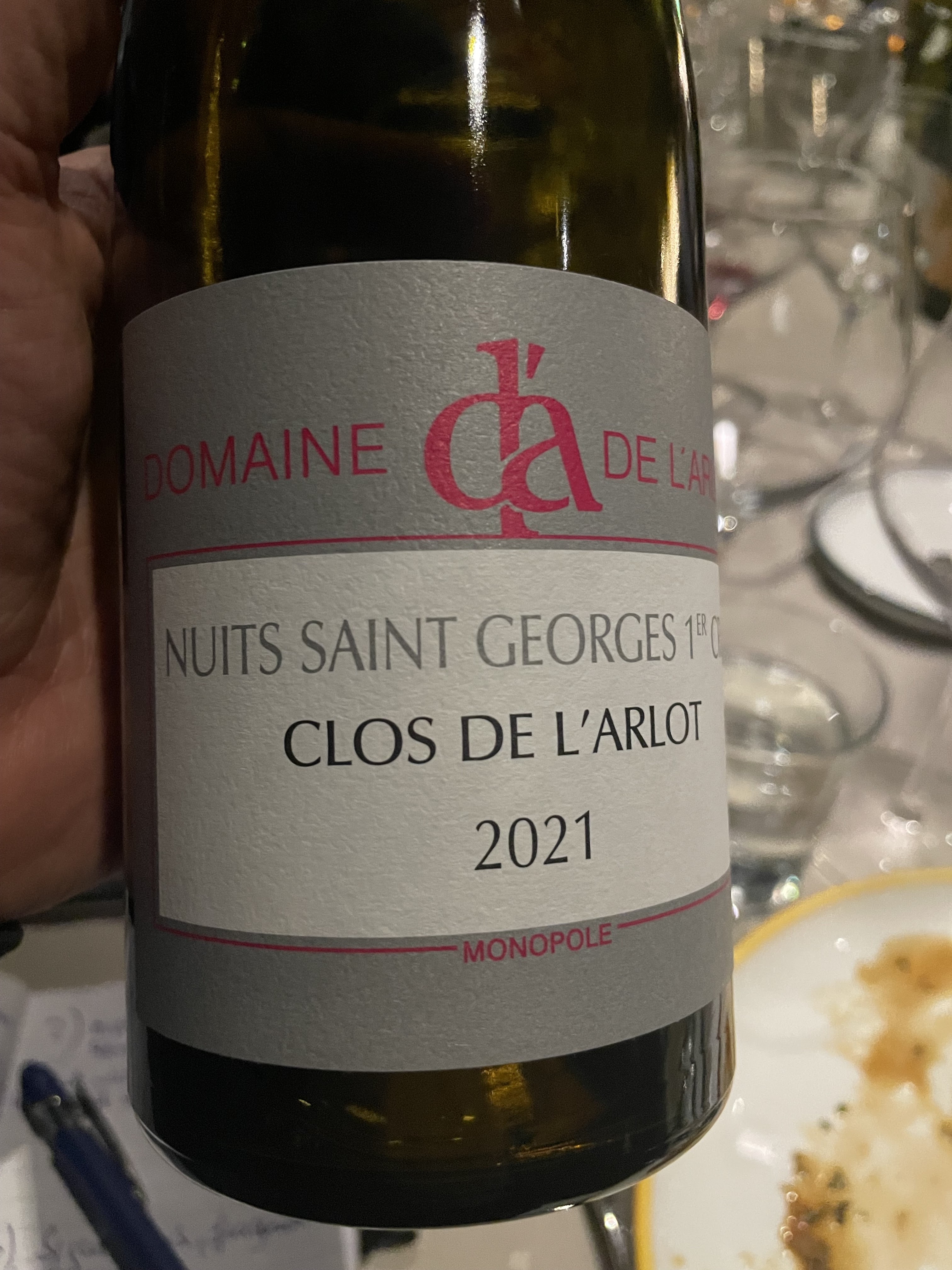
Nuits-Saint-Georges Clos de l`Arlot 2021, Domaine de l`Arlot
Lys og elegant i snittet, fragrant og løs duft av bringebær. Hint av sigar med 5-spicy nese. Kjølig frukt i en deilig feminin stil. En super deilig vin som bør kjøpes. Kr. 1 595,- på VP. 94 poeng.
World of Fine Wines:
In October, The World of Fine Wine’s Burgundy critic, Sarah Marsh MW, spent some time working alongside Geraldine Godot, the skilled winemaker at the helm of Domaine de l’Arlot, the AXA Millésimes-owned producer based just south of Nuits-Saint-Georges. A week later she attended an impressive tasting of the producer’s wines in London.
There was an air of serenity in the winery at Domaine de l’Arlot when I visited in October towards the end of the 2021 vintage. Calm, but also quiet, as so many many vats stood empty. There was very little wine made in 2021 on the Côte d’Or. Things got off to a bad start when the budding was damaged by a severe spring frost and at the other end of the season a strict triage at harvest saw a quantity of fruit thrown off the sorting table.
After the frost, it was clear it would be impossible for me to make wine of my own in 2021. Such is the lot of the micro-négociant. The domaines needed every bunch they they could salvage. To put this in context Vincent Boyer, from whom I source my Meursault Les Narvaux grapes, made just four barrels of wine from a 1.5ha (3.7 acres) parcel of vines. With no vintage of my own, this presented an opportunity to lend a hand, or rather keep my hand in, at a few domaines which have captured my attention in recent vintages.
Domaine de l’Arlot: Significant evolution
Among this group is Domaine de L’Arlot, just south of Nuits-Saint-Georges. A domaine where the style has evolved significantly since Geraldine Godot began making the wine in 2015. She is the forth in a succession of winemakers appointed by Christian Seely, managing director for AXA Millésimes vineyard group which bought the 15 hectare domaine in 1987. Seely gave Geraldine a free hand, encouraging her to follow her initiative, and this has paid dividends.
When I arrived in the morning, all ready for work, there was nothing to do but a little remontage on one tank. This had become a theme wherever I went. The typical activity of vintage was sadly absent. I was disappointed not to clamber in the tank for a small workout, but there was no chance as Geraldine decided against any pigeage in 2021. “We don’t have the maturity in the grapes this year,” she remarked. This lack of ripeness is unsurprising as Burgundy experienced a cold and rainy summer, a far cry from the extravagant sunshine of the past four vintages. It’s hard to say what is normal these day, but a 2021-style summer is more typical on the Côte d’Or, as is the battle with mildew, odium, and rot.
Change of approach
“I need to work differently on this vintage,” mused Geraldine. “I have lessened extraction and am working more softly.” This is no surprise. Over the past six vintages Geraldine has tweaked the winemaking in judicious ways. Consequently the style has become lighter, more elegant and has greater transparency to the terroir and a purer expression of the vintage.
“It’s so much easier to get color and tannin compounds than it was ten years ago, so every year we must adapt our methods,” she comments. The skin was quite thin and not perfectly ripe in 2021, but the extraction was better than Geraldine anticipated. “I want to see what happens if I only use pump over. Will we have the same expression of Pinot Noir? This vintage is a good time to reflect on our approach. At the moment it seems that it was a good idea.”
After all Clos de L’Arlot is not the terroir form which to make stereotype, firmly structured Nuits-Saint-Georges. Lying at the tail end of the appellation the domaine is actually in the commune of Prémeaux and here the style becomes progressively lighter. The bedrock is limestone, and in a few places marl with an abundance of oyster fossils, and a top soil of clay-limestone mixed with gravel. At the southern-most end, Clos de l’Arlot abuts the Nuits-Saint-Georges Premier Cru, Clos de la Maréchale, which is more Chambolle than Nuits in character, in part because it’s made by Frédéric Mugnier. But these vineyards respond eagerly to a lighter touch giving more subtle tannin. When Maréchale was farmed by Faiveley until 2003 and made in a more extractive way, the tannins were robust and the wine burly.
Clos de l’Arlot is a rather bizarre-looking vineyard fitting snugly into an old quarry, where there is a fault in the rock. It forms a small amphitheater offering different exposures and microclimates as well as varied limestone and marl soils. The 4ha (9.9 acres) vineyard is planted half to Chardonnay with a few vines of Pinot Beurot and half to Pinot-Noir. This climat has exemplified the lighter more aromatic style of Nuits under the previous winemakers, but with her careful touch, Geraldine showcases its delicacy and refinement.
A tight-knit team
Geraldine is accompanied in the cellar by a young enologist Laura Poli who came to Arlot a couple of years ago for work experience and was hired full time. Watching her at work, it’s clear Geraldine is a good mentor. During vintage they are joined by Romain Rascault, Geraldine’s partner, who takes care of the vineyards. The approach at the domaine is organic and largely biodynamic (no surprises as Rascault came from Domaine d’Angerville), but there is no wish to be certified.
At the end of the morning we went to taste the vat samples in the light-infused, sleek tasting room. During vintage this small, tight-knit team taste each cuvée away from the distractions of the winery. The wines are assessed midday so that any operations can be carried out in the afternoon. Having tasted at other domains, at the end of the day, tired and with sensory overload of fermentation in the cuverie, this is an excellent and more precise, as well as practical, approach.
Domaine de l’Arlot winemaker, Geraldine Godot. Photography courtesy of Domaine de l’Arlot / AXA Millésimes
Geraldine has a fine touch with texture. When I visited she was was working on the creaminess of Cuvée Mont des Oiseaux, (a premier cru of young clones, planted above old vine massale selection at the top of Clos de l’Arlot). The previous afternoon they had warmed the tank to increase the richness of texture. The tasting indicated it had worked, but they felt they could push further to increase the “fat.” (Bear in mind the 2021 vintage is much leaner than the luxurious and recently bottled 2019s.) There are a number of ways this might be achieved and they decided on a rack and return: moving the wine off the skins, warming it, and returning it to the skins, to increase the body and texture. The wines were discussed quietly. Most were nearing completion and soon to be pressed. Across the cuvées, the tannins were finer than I expected of 2021. Clos de l’Arlot showed silky textured finesse.
The monopoles
Nuits-Saint-Georges Premier Cru Clos des Forêts Saint Georges was more firmly structured, as it should be. The domaine has two monopole premiers crus. Clos des Forêts Saint Georges is a wine of grip, body, and density. It’s close in style and location to the more typical south side Nuits, but lacks the sophistication of its near-neighbor, Les Saint-Georges.
At just over 7ha (17.3 acres), there should be six tanks, each showing a different aspect and expression of this monopole, but not with the paucity of 2021. Geraldine explains the vineyard. “There are three different soils. At the top it is white limestone … oolitic limestone. In the middle pink limestone—Prémeaux. Also in the middle and at bottom you find Ladoix limestone, which is surprising as we are in the Côte de Nuits. With three soils we have different age and selection of vine material. It is interesting and complex as we have differing expressions from each part.”
The profile of this wine is typically energetic and more assertive. Pinot Noir on limestone is likely to, indeed should, have more austerity than on clay; a fresh, colder, clipped character to the tannin and edges which I like. It imbues the wine with energy, so useful in warm vintages, but needs careful handling, particularly if there are whole bunches in the vat, and certainly in less ripe vintages.
Clos des Forêts has the structure to age. With a full body and tannic profile, it requires at least four years in bottle as a “drink from” date, while Clos de L’Arlot is always more approachable. In 2019 I tasted a vertical of Clos des Forêts with Geraldine, at the domaine, which spanned 1998 to 2017 with some older ’90s thrown in for good measure. 2002 was particularly exciting as it had developed a satin texture and was still energetic, while 2005 was yet to come around. 2005 is a great vintage, but came before the trend of “infusion.” Most 2005s were over extracted.
In 2015 and 2016, Geraldine’s first vintages, she used 100% whole bunch in Clos de Forêts, but began modifying the extraction. More recently she is gravitating away from using whole bunch. “I have been questioning the use of whole bunch and in 2021, used none at all. I like to reflect and observe the vineyards and maybe change things. The stems were not ripe and I did not want to use them. The de-stemmer was very important. Maybe whole bunches are not so necessary.” This is a significant departure as whole bunch was used systematically prior to her time.
A London tasting
The week following my visit I was back in London for a special tasting of Domaine de L’Arlot, hosted by Christian Seely, and AXA Millésimes’s Communications Director Corinne Ilic. Geraldine presented the five vintages, 2015-2019 for which she has been responsible, and which are in bottle. This included the domaine’s Premier Cru Vosne-Romanée, Les Suchots and Grand Cru Romanée-Saint-Vivant together with Clos de l’Arlot and Clos des Forêts Saint Georges.
I last tasted the 2019s during the ageing process in December, 2020, and it was pleasing to see the extra level of refinement achieved in the final months. Much can be achieved after racking when the lees settle out in tank and the wine gains precision as a result. The textures of the 2019 wines are satin-rich, but not overly glossy. I particularly enjoyed the flowing, silky texture and fragrance of 2019 Suchots with its wild strawberry fruit. It has calmed down from the lush richness and concentration of the barrel sample, while Romanée Saint Vivant is a wonderful lucid wine which captures the vibration of the terroir.
The hallmarks of the 2018 vintage are black fruit richness, morphing into prune, concentration and plentiful, sometimes robust tannin and a modest level of acidity. It can be burly. Nuits-Saint-George was singled out for several storms in July. The rain storm helped bring some freshness to the dry rather de-hydrated fruit, but two hail storms necessitated strict sorting on the vibrating table to eliminate affected berries and hail taint. Some producers managed better than others and it can be a less than exciting vintage for Nuits. While Clos de l’Arlot is somewhat sturdy in the tannin department, I was impressed with Clos des Forêts Saint Georges. It’s punchy with bags of dark fruit. Geraldine has brought out a rich, fruity, and juicy personality in Forêts. She has softened back the texture and achieved a suppleness to the plethora of tannin. Good job.
The light charm of 2017—and the best of the difficult 2016
2017 is a light vintage without much tannin and Geraldine highlights the charm. These are pretty, soft and aromatic wines. It’s possibly not a vintage in which to buy grand cru, but a good year to take pleasure in the charm of village and premier cru. Clos de l’Arlot is a joy. It is wafting and scented with light, fresh crunch to finish.
I also liked the 2016s. Now this is not an easy vintage. A victim of vicious spring frost, the few bunches that emerged, sometimes from a second set, were concentrated with a high level of acidity. Pinot Noir can be a tad strict on limestone soils, especially with marked acidity in the mix. Domaine de l’Arlot harvested in late September to early October.
Not all of those tasting in London were fans of the 2016 reds. It is not a consistent vintage and I struggle to find much enthusiasm for whites, but where the reds are good, I love the energy and the bright and pure Pinot character. Suchots 2016 is lively and vivid and beautifully aromatic on the finish. It’s not as good as 2019, but it is born from adversity. Forêts, predictably, is the most severe of the 2016s. It has a sharp and angular structure. All elbows. Very clipped, but oodles of tension. It needs time.
The 2015s were rather hidden. Concentrated and compact, but closed down. When I tasted Clos des Forêts 2019 it was expressive and the complexity clearly apparent. It makes me wonder if the 2020s will close in the same way. So difficult to tell.
At this round table tasting there was a surprising level of interest in the percentage of whole bunch used in every wine we tasted, which ranged from zero to 100%. I didn’t bother writing it down, so I can’t comment. It seemed unnecessary and rather missing the point. The salient point is that Geraldine used whole bunch when she felt the wine would benefit, and as such it should not be obvious, and it wasn’t. She is a discreet winemaker who allows the terroir full expression without a masking of technique
Årgangen 2021 er ikke en topp årgang i burgund, verken for hvit eller rød.
Vinteren var både mild og våt og det fortsatte med 25C+ i slutten av mars ! Etter tidlig og ivrig knoppskyting kom frosten 5. april med minus 6 minus ! Ikke lokal frost som i 2016, men generelt i hele området med snø 7. april. Det ble iverksatt massive tiltak bla. oppvarming med varmebluss, dette er et tiltak som flere nå ikke iverksetter både pga. sitt miljøengasjement, men også mht. kostnaden (betydelig mengder xtra arbeidstimer og ca. forbruk 2 tonn drivstoff pr. hektar pr dag !. Eksklusive produsenter som Comte Liger-Belair satte ut 800 varmebluss pr. hektar og på den måten hevet temperaturen rundt vinplantene fra minus 9C til +2C !) Flere beskjærer også nå vinplanten senere slik at det er mindre vinskudd når frosten kommer. Og flere produsenter legger "cover crops"/gress/høy mellom vinrankene for bedre frostbeskyttelse.
Frosten slo hardest til mot chardonnay som blomstrer tidligere. Flere vinmarker mistet 80 til 100% av druene, noe som medførte omfattende deklassifisering av Grand Cru materiell til 1cru og fra 1cru til kommunevin. Og det ble ikke bedre. Det kom mye regn om sommeren og betydelig innslag av meldugg. I 2020 var det 333 soltimer og i 2021 var det 210 soltimer, men pga frosten var det færre bær å levere sol til ! Vinhøsten ble nok reddet av en solrik periode i slutten av august og i begynnelsen av september. Tidvis regn ved en sen innhøsting 20. september gjorde ikke saken bedre, fordelen med mye dårlig frukt er at du må sortere xtra hardt når druene kommer i hus og flere produsenter i Beaune (rød) var relativt fornøyd med kvaliteten. Flere hadde for lite vin til å fylle opp tønnene (som er større i burgund enn i bordeaux), derfor ble det endel mix/deklassifisering - vinification intêgrale
Bruk av druestilk og helklasefermentering ble utfordrende dette året. Helklase og druestilk hjelper til med å fylle vintønnene samtidig som de reduserer syrenivå. Umoden stilk, som det var mye av dette året, resulterer i "grønne" viner så her måtte vinmakeren ta kloke valg.
Generelt gikk det tregt med alkoholfermenteringen og det var stor variasjon fra produsent til produsent hvor mye ekstraksjon/pigeage som var ønskelig. Som nevnt klarte man ikke å fylle opp store vintønner og flere brukte feuillettes (halvparten av 228 liter pieces) eller quarteaus (57 liter) Dette medførte dårligere temperaturkontroll og større innslag av eik enn ønskelig. Malo gikk sent, flere viner var ikke klare da de skulle bli tappet på flaske og det var viktig å lagre de en xtra vinter.
Tross alt dette; vinene fremstår relativt gode og vellykkede !
2021 er "back to normal", litt undermoden og grønn, klassisk og frisk i stilen. Transparent, lys, klar og som et motstykke til den mer konsentrerte, ekstraherte og mørke stilen i 2020. Det er stor variasjon både mht. produsent og områder.
Som sagt, det ble laget lite hvitvin og mye av det som ble laget ble reddet av en varm periode i slutten av august og i begynnelsen av september. De har paradoksalt nok spor av et varmt år med innslag av moden tropisk frukt som balanserer en moderat syre. Kvalitetshiarkiet mht. kommune/1cru/Grand Cru kommer ikke så godt fram i årgangen, så det kan være mange gode kjøp. Spesielt Chassagne Montrachet trekkes fram som et vellykket område i årgangen, mye pga. dynamikk mht. nye og unge produsenter.
De røde har livlig rødbærsfrukt som kan minne om tidligere kjølige årganger med snev av blodappelsin, tydelig mineralitet, små tanniner, lav alkohol og således veldig forskjellig fra den heftige stilen til 2019 og 2020. De er overraskende lite grønne til å ha fått så lite sol, men kan fremstå litt anemiske med for lite frukt. Vinene fremstår ikke i dag med et stort lagringspotensiale.
Teksten er basert på Vinous/Neil Martin
Virrê-Clessê 2021, Hêritiers du Comte Lafon
Transparent blek farge, syrlig citrus med hvite blomster og lett tropisk. Ung vin med medium syre. Bør lagres ytterligere. 60 år gamle vinstokker og drevet biodynamisk. Appelasjonen ble opprettet i 1999. 87 poeng.
Macon Uchizy 2021, Hêritiers du Comte Lafon
God intensitet med snev av pasjonsfrukt, fersken og melon. En elegant vin med medium konsentrasjon, aromatisk og denne fortjener også litt lagring. Druer fra "Les Maranches", men i 2021 ble 90% borte pga. frost. Comte Lafon startet Heritiers i 1999. 89 poeng
Macon-Villages 2021, Pierre Boisson
Hvit, rolig frukt. Spearmint, eik og tørrer endel på finish. Litt grov og uelegant med flabby finish. 86 poeng.
Puligny Montrachet 2021, Domaine Alain Chavy
Fersk vin med grønnlig skjær. Medium konsentrasjon med moderat intensitet. Mangler litt dybde og personlighet. 89 poeng
Chassagne Montrachet 2021, Domaine Blain-Gagnard
Transparent grønn med god mineralitet, steinaktig, endel eik og en pen vin. Synes produsenten lager bedre vin enn tidligere. 90 poeng
Chassagne Montrachet 2021, Jean Claude Ramonet
Aromatisk tutti frutti på nesa. Lett tropisk i en overraskende moden og åpen stil. Men vinen har en god fruktkonsentrasjon med snev av pære og melon. 90 poeng.
Puligny Montrachet 2021, Domaine Leflaive
God konsentrasjon, kompleks og spennende. En seriøs vin som blir slankere i glasset og blir da trangere i formatet og litt Pucelles-aktig. 91 poeng.
KONKLUSJON HVIT BURGUND 2021:
Basert på denne smakingen viste årgangen en overraskede åpen profil, vinene var lette og manglet kompleksitet. Overraskende modne viner, for mye tropiske elementer og er usikker på om disse vinen blir spesielt bedre ved lagring.
Det er mye flaskevariasjon på eldre champagne. Ikke det at jeg har noe statistisk grunnlag for å si det vs. f.eks. røde viner, men for meg skal en god flaske eldre champagne fremdeles by på mye vitalitet med syre, spenst og energi. For 50 år siden trodde nok de fleste at drikken med sin spesielle lukkemekanisme og CO2 hadde en iboende lagringskvaliter framfor sine rivaler i rødt og hvitt. Men det viser seg; det har de ikke. Nå kan årsaken også ligge i at man trodde lagringsforhold ikke var så viktig, fremdeles er man ikke enig om flasken skal ligge eller stå ! Mange champagner er nok også blitt gitt som en litt for dyr gave, der gavemottaker synes ingen anledning er stor nok til å sprette flasken som kan gi assosiasjoner til både luksus og overflod ! I de siste årene har derfor endel eldre champiser dukket opp på Blomquist og alle flaskene drukket denne kvelden var kjøpt der.
Dom Perignon 1982
Årgangen ble endel hauset opp, men flere flasker det siste tiåret har vært slitne, modne og mistet trøkket. Derfor var det veldig hyggelig at denne var frisk og viste seg fram fra en god side. Gylden lys cognac farge, elegant og litt hul og spinkel frukt. Men frisk og pen og syrlig med toner fra grapefrukt, mandarinskall, og lysere frukt. Lite kaffe og mokka her. Bare superelegant i en chardonnay/Blanc de Blancs aktig stil. Men bør nok drikkes nå, den mister endel mousse. 94 poeng
Dom Perignon 1988
Årgangen ble hauset opp med god grunn, fremdeles finnes det flasker der ute som trenger flere år på langs (eller stående !) Lysere hue enn 82, lysere også i frukten, snert og spenst, men samtidig en helt annen kompleksitet i frukten. Overraskende sammensatt og rik for årgangen. Denne har mye å gå på, tidligere oppfattet jeg årgangen som litt trang og lite giving, nå utfolder de beste flaskene seg. Må være en av de beste Dom som er laget. 96 poeng
Vinklubben juni 2022:
Dom Perignon 1988
Gylden og utviklet, endel Pinot, rik vin med noe bitter finish. Herreskuff og mahogny, Kompakt og fruktig. Synes kanskje den hadde litt lite "løft". Steinfrukter med endel dosage. Overraskende lite "88 stil". 92-97 poeng. Knut var spesielt glad i denne. CHAMPAGNE OF THE YEAR 2022 ! Medtatt av Roar
Dom Perignon 1990
Korket. NR
Men denne har imponert voldsomt tidligere i Vinklubben:
Dom Perignon 1990
Lys gylden med en pent utviklet moden nese av brioche. Klassisk stil, en super flaske dette, citrus, frisk syre intakt med snev av grapefrukt i finish. Holder seg veldig godt, men mangler tidligere flaskers kompleksitet. Eller er det på tide å drikke opp ? Medtatt av Jon. 94 poeng
Vinklubben har drukket flere flasker tidligere: Dom Perignon 1990
Frisk og elegant og flere trodde dette var en 2002/2008 ! Endel Pinot fornemmes, en klassisk briochenese og en tydelig toppcuve i formatet. Stor kvalitet med en superb balanse. Ren i snittet med appelsinzest og citrus. Nesten for perfekt i munnen. Endel eik, men en strålende flaske. CHAMPAGNE OF THE YEAR 2019 ! Medtatt av Roar. 97 poeng (Kim ga den hele 98 poeng)