torsdag 18. april 2013

Pol Roger 1986


Vinmøte Jon 17.4.13


Champagne Bereche & Fils NV Brut Reserve

Stram, elegant og syrerik. Mangler kompleksitet og litt for spinkel kropp. Distinkt syre og eplekart. Vi gjettet på en eldre vin. Base 2010. Degorgert oktober 2012. Vi har ikke drukket noe fra denne produsenten tidligere i Vinklubben. 87 poeng


Pol Roger 1986 Brut Chardonnay

Strågul farge mot gylden. En deilig aromatisk eldet champagne. Moden med ristede nøtter, champignon, skogbunn og snev av sherry. Ikke lett å ta denne som en Blanc de Blancs. Kim tok champagne og årgang ! 92-95 poeng.


Kim tok denne med på Champagne of the Yera 2011 (21.5.11) Frisk og strågul. Epler og autolyse med et forfriskende bitt. Servert litt varmere enn de andre. En rik og utviklet stil. Noe slapp mousse etterhvert i glasset. Deilig sjøpreg. Toner av honning. En rik og karakterfull champagne. En enormt surt og friskt bitt hever vinen synes jeg. På toppen nå ? 94 poeng.

Pol Roger founded this eponymously named house in 1849, although it was not quite as we know it today. The house was named simply Roger, and Pol, who was the son of a notary and owned no vineyards at all, made his living largely by making Champagne for other houses. But when the thriving family business came to his sons, Maurice and Georges, in 1900, they honoured their father by changing their surname to Pol-Roger. And thus the family business also became Pol Roger. Maurice was very much the public face of the company, whereas Georges was much more active in the blending and tasting rooms. Maurice Pol-Roger was a legendary figure in the history of Épernay and Champagne. His iconic status was assured when, as mayor of Épernay, he resisted the efforts of an invading German army to enter the town in 1914. The grateful townspeople continued to re-elect Pol-Roger as mayor until 1935 when, anxious that he may step down after so many years in post, they bestowed the honour upon him for life. But death comes even to mayors, and so in 1959 Pol Roger passed to Maurice's son, Jacques, and nephew, Guy. This partnership ran the firm until 1963 when the fourth generation, Christian Pol-Roger and Christian de Billy, took control. The two Christian's run the show still, with assistance from Hubert, son of de Billy, since 1988.

Although the business started without a scrap of vineyard to its name, a situation that persisted until 1955, Pol Roger currently owns 55 ha largely in and around Épernay. On the Côtes des Blancs these include sites in the Grands Cru villages Cramant, Chouilly and Avize, and Premier Cru villages Grauves and Cuis. On the Montagne de Reims they own vineyards in Grand Cru, Ambonnay, Bouzy and Verzy, and Premier Cru Trépail, as well as numerous lesser vineyards. I always find great style and finesse in Pol Roger. There are a number of non-vintage and vintages cuvées available. The non-vintage cuvées, of which there are two, are characterised by the inclusion of one-third each of Chardonnay, Pinot Noir and Pinot Meunier. In my experience the Brut Réserve is an excellent example of the style. I have little experience of the demi-sec Rich. The Chardonnay Vintage is the Pol Roger blanc de blancs, and is very good indeed, and there is also a vintage Rosé. But the two wines on which the house has earned such a tremendous reputation are the vintage Brut and the prestige cuvée, Cuvée Sir Winston Churchill.

The Brut Vintage Champagne is one of Champagne's greatest wines, and is certainly a contender for 'wine of the vintage' in many years. It is a blend of 40% Chardonnay and 60% Pinot Noir, the only relatively recent exception being the 1966, which had 65% Pinot Noir, although some vintages from the first half of the 20th Century were up to 80% Pinot, and the 1928 was, exceptionally, 100% Chardonnay. The persistent high quality of the Brut Vintage is down to the combined efforts of the Pol-Roger family, with increasing input from Hubert de Billy, together with chef de caves James Coffinet, who was replaced in 1999 by Dominique Petit, who came to Pol Roger from Krug. 
Finally, I cannot fail to discuss in more detail Cuvée Sir Winston Churchill. Pol Roger was Churchill's tipple, and his relationship with the house was cemented when entranced by Odette Pol-Roger, Jacques' wife, when he met her at the British Embassy in November 1944. Churchill became Pol Roger's best, and certainly most influential, customer. He named a winning race horse after Odette, which I think is a compliment. After his death, Pol Roger placed a black border around the labels of Brut NV shipped to the UK. And, in 1984, they released a prestige cuvée named after the great man, starting with the 1975 vintage. The launch of the wine was a grand affair, attended by Lady Soames, Churchill's daughter, who commented of her father, "I saw him many times the better for it, but never the worse." The blend for this cuvée is a closely guarded secret, but it is likely to be a Pinot-dominated cuvée, reflecting the style of wine that Winston preferred. My personal experience of mature vintages would seem to bear this out; the 1986 seemed very Pinot dominated. The 1985 was less so, but was not at full maturity. 


GODT KJØP: Lanson Gold Label 1998 brut er et meget bra kjøp. Høy syre, god fylde og god lengde. Den deler førsteplassen, men koster under halvparten av en Dom Perignon 2000.


Champagne Gold Label 1996

Gul og gylden Blanc de Blancs ? Sure rips, zalo og gule plommer. Aggresiv syre. Powerfull munnfølelse, litt for dominant syre. Kraftig og generelt sier folk det er mye flaskevariasjon på denne. Men de Vinklubben har hatt har vært bra. 91 poeng

Fra Vinforum:


Champagnene til Lanson kjennetegnes ved å være nonmalo, altså laget uten malolaktisk gjæring, noe som skaper en relativt syrlig stil. I tillegg er den sublime årgang 1996 i seg selv karakterisert ved en distinkt syre, og med en høy andel pinot noir resulterer dette i en svært rik og relativt syrlig champagne av eksepsjonell kvalitet. Den er god å drikke allerede nå, men vil fint tåle ti år til i kjelleren.


Lanson Gold Label Brut 1996
Champagne
#42609, kr 369
53% pinot noir og 47% chardonnay. Frisk, ren og eplepreget champagne med innslag av lime og toast på duft. Rik, syrlig, stram og flott vin med distinkt eplepreg også i munnen og sublim lengde. Intens, rik og elegant vin som fortsatt har mange år å gå på.
Mat: Aperitiff, fisk, kylling, juleribbe.

fredag 12. april 2013

En skuffende Chambolle Musigny 1990 fra Comte de Vogue

 
Vinmøte Lars Ivar 21. mars 2013


Nuits Saint Georges 2009, Tesco

Middels anonym nese med enkel rødbærsfrukt. Frisk og grei sommervin. Lett Pinot, noe grønn og får nok litt hjelp av årgangens rike stil. Men under kr. 200,- for en Nuits St. Georges er helt OK (£ 19.99) 85 poeng


Chambolle-Musigny, Derriere la Grange 1er Cru, Collection Bellenum

Chambolle Musigny 1cru Derrière la Grange 1993, Maison Roche de Bellene

Pen munnfølelse, holder seg veldig godt, frisk og grei. Litt kjemisk/grønn note. Lars Ivar prøvde å prate opp denne uten hell. Viser årgangens holdbare stil. 88 poeng.


Pinot Noir 2010, Domaine Drouhin-Williamette Valley Oregon

Lilla, parfymerte sommerblomster, vulkansk, granittaktig, plommer, sjokolade og mye nyanser. Litt eksotisk med spontangjær-aktig nese og en deilig sådan. Kim sa dette ikke var Burgund, Roar veddet imot ! Kim var både i Beajoulais og i Rhone. Fjøsaktig, men fremdeles en ren og skarp, fin fruktprofil. En del fat med innslag av flosscandy/sukkertøy. 86-89 poeng.


Chambolle Musigny 1990, Domaine Comte Georges de Vogue

Mørkere frukt med skogbunn, sopp og rosin. Tørr og skarp syre. Ikke en optimal flaske. Øyvind var i Piemonte/Barbaresco. Synd, dette skal være bra. 80 poeng.


Fra burgundy-report:

It was around 1880 when the Côtes de Nuits village of Chambolle decided to improve its profile by appending the name of its most illustrious vineyard, thus to become Chambolle-Musigny. Despite this early attempt at marketing, Chambolle-Musigny has remained a working village rather than a place for tourists. Today, however, you will find two restaurants and a good hotel, though fifteen years ago all three were missing; there was once a vegetable shop too, but it didn’t last…
The village nestles in a small cleft at the base of a steep wooded hillside, the Combe de Chamboeuf. Through the centre of the village runs (mainly underground) the river Grône from which it is said the village takes it’s name: Though referred to as Cambola in the year 1110, it is believed that the name Chambolle derives from the regular bursting of the banks of the Grône during heavy rain, a ‘champ bouillant’ if you like.
Chambolle’s ancient church (monument historique) is worth a visit, some of the paintings here were bestowed by de Vogüé’s ancestors; if you enjoy the grisly art of the late middle-ages I can particularly recommend the painting of a scene from John the Baptist… The roads in the village are often narrow and winding; one such road follows the lower side of the church, part-way down you will meet an archway on the right-hand-side, an archway that will lead you into the 15th century courtyard of the Domaine Comte Georges de Vogüé, built by Jean Moisson in the 1400′s this has always been the home of the domaine.

The domaine – Past & Present


de vogue

Many domaines in Burgundy can trace their roots back over 100 years, though since the majority of the vineyards were owned by the church and aristocracy until ~1790, only a handful of domaines can claim more than 200 years of history. The Domaine Comte Georges de Vogüé, however, can trace a line back over 550 years to ~1450 and the Chambolle vines of one Jean Moisson (as above). Today it is the 20th generation of the family that head the domaine; Claire de Causans and Marie de Ladoucette, the granddaughters of the late Comte Georges de Vogüé (1898-1987) who is pictured right. Comte Georges took over from his father Arthur in 1925, changing at that time the name of the domain from Comte Arthur to Comte Georges, though from around 1980 Comte Georges’ daughter, Elizabeth, took ever greater responsibility. Following the death of her father, it was she that decided to put a new team in place; Gérard Gaudeau tended the vines, though today that position is held (since 1996) by Eric Bourgogne – a most fitting name – Francois Millet was made responsible for the winemaking at the retirement of Alain Roumier, and in 1988 Jean-Luc Pépin, ex Domaine Joseph Drouhin, became responsible for the sales. For a short time before the arrival of Jean-Luc, Elizabeth’s son-in-law Gérard de Causans, husband to Claire, took the rôle of finance and sales, but was sadly cut-down in his prime by terminal illness.

De Vogüé and family Roumier

For many, many years a Roumier was instrumental in the work of the domaine. Alain Roumier was the régisseur for the domaine during the time of Comte Georges, as apparently was his father and grandfather before him. As reported by Robert Parker, it was Alain Roumier who famously suggested that if the wines of the seventies and eighties were not quite as good as before, then blame “Americans’ obsession with brilliant, clear wines” and the subsequent need for the domaine to filter. Of course, this being a family affair, it wasn’t just Alain that was involved; study the photo above of Comte Georges, and the man in the outsize beret and glasses to his right is Georges Roumier, uncle of Christophe from today’s Domaine Georges Roumier.


looking down on the chardonnay vines


Working the vines – Eric Bourgogne walks you through the vineyards talking of the domaine’s philosophy; they practice ‘lutte raisonée’ (reasoned battle) which is effectively intervention only as required rather than treatment as prevention. Eric points out that in the challenging 2004 vintage (hail, oïdium, rot) they only sprayed six or seven times, most biodynamic domaines would have made double that number of treatments. In common with most domaines in Chambolle they also practice ‘confusion sexuelle’ – these are the small brown tags of insect pheromones that you see on the end of the rows of vines. Eric believes that a balance of insects is best, as treatments against one insect type will often have negative consequences for beneficial predators. Across the domaine Eric uses three types of pruning; Guyot, Cordon Royat and for the young vines a formation pruning.
Within Musigny, they now allow the weeds and grass to grow between the rows throughout the autumn and winter, ploughing by horse from Spring onwards, they use no weed killer. Eric believes that these choices result in less-compacted soil and significantly less erosion than the domaine used to experience. The domaine puts their own compost on the vineyards at a rate of 2 hectares per year, this translates to an addition of compost every six years. It’s very interesting when you look up the rows in Le Musigny, despite no difference in treatment, the grass between the rows suddenly stops as the vines change from mature pinot to young chardonnay. Something to do with shallow roots and less soil? – Who knows…?

A whiff of controversy

It comes with the territory; like Domaine de la Romanée-Conti and to a lesser extent also Domaine Leroy; the high prices asked for the wines set a certain level of expectation, add into the mix the overwhelming ownership of one of the most gifted terroirs and expectation is exponentially greater. As Matt Kramer said (Making Sense of Burgundy, 1989) the wine should “deliver the exhilaration one has a right to expect from Musigny”. In some ways it is even tougher for de Vogüé as there are other Musignys around to provide a benchmark, anyway we shouldn’t feel sorry for the domaine as they are in a fortunate and responsible position: It is, however, precisely because they are in such a position that so many people feel the need to pass judgement – some informed, some not. Today at least, if something needs to be done, it is done. The perfect example is what they did in 1991; a localised hail-storm ripped through Musigny, heading north until it stopped on the border with Morey St-Denis. Francois Millet’s quick pre-harvest vinification of the Musigny showed the taste of hail, so sixty people were used (it is said with tweezers) to remove every single damaged grape, and what a clean wine it is today.
Almost all commentators talk of a mid-1970′s to mid-1980′s dip in quality, so no smoke without fire but some seem reticent to accept that the ‘old quality’ – whatever that means – could once more be found in the wines of today. The 1990 Musigny is an interesting example: those that tasted from barrel saw greatness, those currently tasting from bottle are often underwhelmed, calling the wine Bordeauxesque. Without saying so directly, Francois Millet gently chides those that comment on the wine today, saying that ‘only those who tasted from barrel, know the true potential of that wine’. I find myself drawn to his viewpoint; all those great Musignys of the 40′s, 50′s and 60′s were proclaimed great when they were 30+ years old, the 1990 has plenty of time before it needs to ‘deliver’.

Summary

I think it is quite fair to comment on the constituent parts of young wines and indeed what we believe the future might hold for them but the real truth will be available to all only once they reach maturity. I see an exemplary quality to the domaine’s wines but there is also a linearity, a haughtiness, a slight lack of ‘warmth’ if you prefer. However you wish to describe it, relative their peers, there is a lack of charm in these young wines. I stress young, because the 1993 villages and the 1992 Amoureuses show both charm and character, perhaps then, it really is just a question of time. If that is the case, then an equally important question is: how do you know when the time is right? Both Francois and Jean-Luc are happy to emphasise – call and ask us – they keep enough half-bottles to test the wines from each vintage on a regular basis. I really should try and visit next time they open their 1990s…
It is never cheap to produce the best wine possible, that said, the domaine’s wines have always been priced above most pockets. I believe that in the 1990s the wines excel in the context of each vintage but if you consider that an average 1993 is significantly better than an average 1992 or 1994 then it’s also possible to point to a spectacular lack of value in ‘lesser’ vintages, but I’m convinced that they are worth every penny in the good vintages – which happens to be most of the last 15+ years. I’m sure my 1999′s could outlive me, though of course, I’d be disappointed if they had the opportunity…

The history of Musigny


Gaston Roupnel
  
The Domaine Comte Georges de Vogüé is inextricably linked to the Grand Cru vineyard of Musigny – in some eyes the pinnacle of pinot noir – a wine that should be both complete and profound but never heavy: ‘majesty itself’ claims Clive Coates. Until 1936 the vineyard was conveniently (compared to some others) split into just two areas/climats, a narrow east-west track splitting the climat of Le Musigny from the more southerly and slightly smaller Les Petits-Musigny. In 1936 the Musigny AOC was extended to cover an additional area of just over 0.61 ha in the adjacent 1er Cru climat of Combe d’Orveau – these are the vines of Jacques Prieur whose domaine successfully argued that wine from this plot had always been called Musigny. De Vogüé have the monopoly of the climat Les Petits-Musigny – though as Jean-Luc Pépin points out, it’s not legally a monopole, and more importantly, if bottled separately it would take away part of the overall blend that they call Musigny Vieilles Vignes.
The only ‘Tête de Cuvée’ reported in Chambolle by Dr Lavalle (1855), Musigny lies at an altitude between 260 and 300 metres, sitting just above the Clos de Vougeot and Chambolle-Musigny Les Amoureuses. The vineyard is relatively flat at it’s junction with the road to the east (at least in Les Musigny) but quickly rises with an incline of around 10° to it’s western boundary. Below the soil is a mix of Bathonian and Bajocian bedrock – limestone – this limestone is particularly hard (unlike the limestone in de Vogüé’s Bonnes-Mares) causing many fissures as water freezes in it’s cracks. Given the depth of the local quarries this bedrock could be as deep as 200 metres. Walk up-slope about one-third of the way into the vineyard and there is around 40cm of soil covering the rocky base, walk another third in the same direction and there is as little as 20cm of soil.
One suggestion for the origin of the vineyard’s name comes from a Gallo-Roman name – Musinus . Others suggest that it came from a prominent family by the name of Musigny who was recorded as having lived in Burgundy at the time of the Ducs of Burgundy. Anthony Hanson (Burgundy, revised 1999) points to the earliest record of the vineyard dating from 1110 “when the Canon of Saint-Denis de Vergy, Pierre Cros, gave his field of Musigné to the monks of Citeaux”. There is also cause for confusion; before the French Revolution there was also a sub-climat within the Clos de Vougeot called Les Petits Musigny – presumably the part now called Musigni – we can only guess what the current ‘Les Petits Musigny’ was called at that time…
A selection of wines were drunk and compared on two separate days; the first a January dinner in London organised by the, then, newly appointed UK agents for de Vogüé, Corney & Barrow, and the second, for the 2000 vintage reds, on a cold February day at the domaine in Chambolle-Musigny.

Musigny Blanc to bourgogne blanc

It is the location that is classed as Grand Cru, so red or white (assuming the AOC is in place), if the grapes come from Musigny the resulting wine is entitled to the Musigny label. Robert Parker (Burgundy, 1990) wrote that the Chardonnay vines of Musigny were “planted at the request of the late Comtesse de Vogüé”; at the domaine today there is no direct evidence of that, or an exact planting date, but what is sure is that there was definitely a white Musigny produced as early as the 1930′s, so the Comtesse would have been quite young for making such a ‘request’. Today ‘only’ a Bourgogne blanc is produced, but potentially this is the only Grand cru white from the Côte de Nuits; though in the the nineteenth century it was also possible to find Chambertin blanc but the vines were already gone when AOC rules were introduced in the 1930s, hence, no AOC is now in place therefore Chambertin blanc is no-longer allowed. This white wine of Musigny is made from chardonnay vines sited, in two plots, right at the top of the Musigny vineyard. Because there is no such AOC as Chambolle-Musigny Blanc (villages or 1er Cru) if the Musigny Grand Cru label is not used, it follows that the wine must be declassified all the way down to Bourgogne (blanc). The 2000 vintage comes from a plot of 0.4 ha, the average age of these vines is currently 14, there are still some vines of 40-45 years but the majority were replanted in 1986, ’87 and ’91. There is also an additional plot of 0.2 ha which was replanted in 1997. The domaine doesn’t yet see sufficient depth and complexity from these vines for the Musigny label, this is despite legally requiring only three years from planting to using a Grand Cru label. They feel that the 2000 wine is some way between a village and a 1er, though 2001 & 2002 in their opinion is firmly at 1er cru quality. Around 20% new wood is typically used for this wine’s elevage, a mere 100 cases per year trickle into the market.

Chambolle-Musigny premier cru

Despite owning portions of Les Baudes and Les Fuées in addition to their holding in Amoureuses, there is actually no premier cru wine in these bottles, only the declassified juice from the young (under 25 years) Musigny vines – Musigny in short trousers as the domaine likes to call it. The first outing for this wine was the 1995 vintage – before this time quite a lot of juice was sold to the negociants and bore a Musigny label. Today there are about 2.8 hectares of these young vines, producing around 500 cases of Chambolle-Musigny 1er Cru per year.

Chambolle-Musigny 1er Cru Les Amoureuses

The highest part of the Amoureuses vineyard is separated from Musigny by a small road, it is here that the domaine’s 0.56 ha holding is located. The vines average 31 years-old and produce a mere 160 or-so cases per vintage.

Bonnes-Mares Grand Cru


The domaine owns a block of vines accounting for 2.7 hectares and an average production of ~420 cases per year. The vines are located entirely in the Chambolle portion of the vineyard that is closest to the village itself, this provides for a slightly more elegant Bonnes-Mares, but one that is heavily scented with violet and peony. The domaine’s vines average 29 years old.


Nuits-Saint-Georges 1cru Les Perrieres 2009, Domaine Jean Chauvenet

Frisk Pinor med strøk av pepper i finish. Mørk, litt varm, mye krydder. 89 poeng


Description

Christophe Draag, son-in-law of Jean Chauvenet has taken the lead of the domaine . Wines tend to be powerful in their youngness and not easy to appreciate but give them some time and you will rediscover the real pleasure of top Bourgogne from the Côte de Nuit.  €49.60


La Porta di Vertine 2008, Chianti Classico 

Mørk og brunelloaktig. Tett, frisk, lakris og fatpreget finish. 86 poeng


About the wine: This is the first vintage in which Sangiovese fruit was harvested from the Colle ai Lecci property and blended into the wines. The vineyards at Colle ai Lecci have a large proportion of old vines (40 years and older) producing minute quantities of very concentrated grapes.
After the arrival of the grapes into the cellar the fruit was destemmed but not crushed. This delays the beginning of fermentation and creates more regular and lower temperatures, an important factor, as the fruit is fermented without any temperature control. Fermentation is triggered by indigenous yeast and without any addition of sulphur. Remontage with aeration was used in the first couple of days to help start fermentation, and obtain good color extraction. The wine remained on the skins for three to four weeks, after which it was racked off into 25 hl old casks and tonneaux. The wine stayed on the fine lees without any racking or movement until the following harvest, after which it was racked off and transferred back into cask for another 8 months of ageing. After bottling the wine was estate cellared for an additional year. Grape variety: Sangiovese, Canaiolo, Colorino, Pugnitello


Barolo 2009, Tesco

Lys og lett Barolo. Frisk og burgunderaktig. Vi var på Poggio Sotto/Brunello. 86 poeng

fredag 29. mars 2013

Kongen av Meursault ....Coche Dury


Vinmøte Lars Ivar 21. mars 2013

Meursault 2010, Tesco

Primær, enkel, gir lite på nesa. Transparent, undermoden frukt og stram. Litt "thight" munnfølelse, Are var på Chablis, mens andre dro til Puligny. Enkel og grei vin, men ikke typisk Meursault. Men en hyggelig pris £ 20,99. 84 poeng.


Meursault 1cru Perriêres 1993, Maison Roche de Bellene

Fiskeslo og blåskjell i nesa. Mere gul i fargen og tydelig utviklet. Kiler på sidene i munnen og lite trøkk. Are mente endimensjonal. Noe kork, sitrus og brente fat. Vanskelig vin å vurdere. 82 poeng.

Nicolas Potel, took his first steps as winemaker in the family Estate in Volnay, Le Domaine de la Pousse d’Or. He established his own negoce operation in 1996 , followed by Maison Potel-Aviron in Beaujolais region in 2000 and his efforts culminated in his own  estate, Domaine de Bellene in 2005, with 15 ha of organically-farmed vines in Côte de Beaune.  In 2008, after leaving the SAS Nicolas Potel company, Nicolas Potel launched a new, "Haute Couture"-style negociant business called "Maison Roche de Bellene" which focuses on offering the rare and fine cuvées.  The Bellene range encompasses wines from the Côte de Nuits, and has the widest selection of Grand Crus from Burgundy, as well as a number of prestige 1er Cru cuvées such as Chambolle Musigny 1er Cru Les Amoureuses, Gevrey Chambertin 1er Cru Les Combottes.  Recently , Nicolas Potel introduced a range of very rare older vintages, under the name "Collection Bellenum".  These exceptional wines, dating back from 1959 are the result of a strict selection of old vintages originating from the cellars of some of the most acclaimed wine producers in Burgundy.


Meursault Poruzots 2007, Francois Mikulski

Transparent, citrus, litt kort. Ganske kompleks, pen fedme, rik men fremdeles slank og god. Sammensatt vin, frisk munn med bra løft. Litt elde. Denne produsenten lager betydelig bedre viner etter hvert ! 91 poeng


Meursault 2010, Joseph Drouhin

Fat, spearmint på nesen. Enkel munn, følger ikke opp den ambisiøse nesen. Kraftig sak og mangler eleganse. Kim gjettet Leflaive Macon Verze. 88 poeng.


Meursault 2007, J. F. Coche-Dury

Tydelig klassisk hvit burgunder i nesa. Åpner seg etter hvert og tydelig en vin med høy kvalitet. 1cru ? Konsentrert, lang og rik munnfølelse. Snev av harpiks. Coche ? 1% mere alkohol enn de andre ? Litt røkt og brent, men samtidig surt og fullt av sjømineraler. Mye fat, bittert og kompleks. Viser at Coche Dury er veldig konsistent og leverer varene gang på gang. Fantastisk bra vin. 95 poeng.


Domaine was founded in 1920 by Jean-Francois Coche grandfather. Jean-Francois took over the domaine in the mid-1970s from his father, Georges. Jean-Francois Coche was in 1975 married to Odile Dury and this led to the formation of Coche-Dury domaine. Today he runs the domaine with his son Raphael, who has been involved in work at the domaine since 1999. 
Coche-Dury is by all standards one of the best producers of white Burgundy, a position he has occupied for more than 20 years. The most impressive is that he has done so without a large portfolio of Grand Cru vineyards. Coche-Dury has a rather modest production and maintains a very high quality – from AOC Bourgogne to the top of the range. Production approx. 4,200 cases annually.
Coche-Dury put great emphasis on work done in the vineyards, when he is asked about his fantastic succes. There a no secrets he says, just hard work in the vineyards. The vines are pruned fairly heavily, and he only use “green harvest” very rarely. They use no form of pesticides in wine production at Coche Dury, fields plowed and cultivated very carefully to maintain the ecological balance.
Vinificationen is fairly traditional, but with quite frequent battonage. Fermentation takes place on oak cask, and the proportion of new oak varies from year to year, but generally Coche-Dury uses quite a lot new oak. In some years they have used up to 50% new casks on the top wines. The wines are raised in barral for 15 to 22 months, and are bottled without filtration.

Domaine Coche-Dury is today almost 9 acres, of which approximately 6 acres Chardonnay, while the rest is Pinot Noir and Aligote.
The production of wine are scattered in a large number of vineyards, see the table below, and on most of these vineyards Coche-Dury have less than one hectare. The 4.25 ha Meursault village is spread over 5 to 6 parcels typically vinified and bottled separately. In reality there are no wine from the Domaine which is harvested on more than 1 ha of Vineyard, and therefore the quantities of all wines are quite limited.
As seen from the table the vines in several vineyards of very old, and this is perhaps one explanation for the extraordinary quality Coche achieve.

Vineyard:Grape varietiesVine ageSoilArea
Bourgogne BlancChardonney1930, 1958, 1975Clay & Limestone1 ha
MeursaultChardonneyvariesClay & Limestone4,25 ha
Meursault Les RougeotsChardonney1940, 1962, 1973Clay & Limestone0,7 ha
Meursault Les ChevalieresChardonney1958Clay & Limestone0,12 ha
Puligny Montrachet Les EnseignerescChardonney1930 – 1952Clay & Limestone0,5 ha
Meursault Perrieres 1er cruChardonney1950, 1970, 2005Limestone0,5 ha
Meursault Caillerets 1er cruChardonney1960Limestone0,33 ha
Meursault Genevrieres 1er cruChardonneynaLimestonena
Corton Charlemagne Grand CruChardonney1960Clay & Limestone0,33 ha
Bourgogne RougePinot Noir1973-1980Clay & Sand0,75 ha
Monthelie Cote de Beaune RougePinot Noirfra 1987Clay & Limestone0,25 ha
Meursault Cote de Beaune RougePinot Noir1980Clay & Limestone0,12 ha
Auxey-Duresses RougePinot Noir1982Clay & Limestone0,50 ha
Volnay 1er cruPinot Noir1962, 1987Clay & Limestone0,33 ha

The most “common” wine from Coche-Dury is his generic Meursault, which is perhaps not quite as generic as one might expect from the table above. There are in total 7-8 different village Meursaults, all vinified and bottled separately.

Most of those are bottled without vineyard/plot information, but two of them, Chevalier and Rougeots, are sold with the vineyard mentioned on the label. So in reality we are 5 to 6 versions of his generic village Meursault that one may encounter when tasting / buying wine in different countries. Different vineyards/plots bottled as generic Meursault; 
  • Les Narvaux
  • Les Dessous Vireuils
  • Les Vireuils dessus
  • La Barre
  • Chaumes (Clone 548 – a vieyard his son is renting)
  • “Les Tetes-Cassese (seen in the 1986 vintage)”
  • “Les Luchet (seen in the 1992 vintage)”
The generic Meursault comes from the plot Les Narvaux and this should be one of the heavier and fatter of his village wines. This cuvee should also be the one supplied to American importer.
Besides the village wines makes Jean-Francois Coche also makes three 1er crus Meursault Caillerets, Meursault Perriere and Meursault Genevriers. The first two have been made for many years, while Genevrieres was added to the domaine in 2003. In addition to the three Meursault 1er crus, he also makes Puligny-Montrachet Enseignères, and a legendary Corton-Charlemagne, which is nearly impossible to find – and cost a fortune.

Coche-Dury also make some fine red wines from Auxey-dures, Monthelie, Meursault, Pommard and Volnay, and an excellent Aligote.

Coche-Dury has almost legendary status among wine connoisseurs, and rightly so. His wines are something special, and he almost have the same status as Henri Jayer, who was quite unique in Vosne Romanee.

Coche-Dury are very expressive wines that really jumps from the glass. It is not subtle or for that matter aristocratic wines, no they are quite flamboyant wines of almost incredibly high quality.
The first thing you notice is the assertive bouquet of gun powder and hints of popcorn – which can be very distinctive when the wines are young. They also have quite a considerable note of new oak, which together with the various nuances of the chardonney grape gives a complex and challenging nose.
On the palete the wines has very fine textures and freshness that comes from both the soil and the fine acidity structure. The wines are never overripe, but retain their suppleness and finesse. There is a pronounced Coche style, but this does not prevent the individual vineyards terroir to shine through. They are terroir wines but have a quite distinctive style that characterizes all the wines from the domaine.

A large part of the explanation for the high quality is most likely found in the vineyards, where a thorough work combined with very old vines in several vineyards yield som special wines. He manages to make wines that are both fresh and resilient although the concentration is quite high, something very few manufacturers are able to match.
Coche-Dury are, of course, also very skilled in the cellar, but I think it is in the vineyards he makes the big difference, which is probably one of the reasons that nobody has been able to copy his style and qualities.

tirsdag 26. mars 2013

Champagne fra Tesco


Vinmøte Lars Ivar 21. mars 2013

Det er jo et spørsmål som ofte dukker opp i Norge; når Vinmonopolet faller; vil kvaliteten på vin som kjøpes på supermarked bli vesentlig dårligere enn dagens viner på Polet ?

Når man ser på hva som er bestselgere på det norske vinmonopol kan jo ikke kvaliteten bli dårligere. Samtidig lager f.eks. Tesco med sin egen "brand" i Storbritannia  viner av god kvalitet til en rimelig penge. Derfor er en slik smaking som dette lærerikt og nyttig. Og man må såklart smake vinene blindt.

Vi startet først med en øl


Alphadog Red Ale, Brew Dog

Frisk og bittert. Vi er ingen klubb for ølhunder. 68 poeng


Champagne Cuvèe Gabriel Brut 2002, Gosset-Brabant

Tydelig champagne, lett gylden i farge, litt hul i munnen med noe kort frukt. Bitter nedfallsfrukt av epler i en ørliten oksidativ stil. Uharmonisk og mangler struktur. Men den gode årgangen holder den oppe. Vinklubben har ikke drukket denne produsenten før. 86 poeng.


Champagne Premier Cru Brut, Tesco

Meaty og kjøttfull. Mye Pinot ? Hundekjeks, god munnfølelse, fin mousse, smørkaramell. Roar var ikke så imponert og mente dette var sukkertøy. £ 19.99 som jo er en bra pris. 89 poeng.


Champagne Veuve Clicquot Ponsardin 2004

Streng og klassisk champagne der årgangen bidrar til en mere mineralsk stil på "enka". Vi var nesten på Blanc de Blancs og Lanson ! Syrlig stil med sitron, gjærtoner og kjeks. Litt tynn frukt, en stil som kanskje ikke kler denne cuvèen ? 87 poeng


Champagne Cuvèe des Moines Brut, Besserat de Bellefon

Litt mere farge enn Veuve Clicquot`en, blank og klassisk. Non-malo, syrerik, rik frukt, korrekt og bra matchampis. Elegant sak som er "hus-champagnen" på restaurantene til Alain Ducasse. 92 poeng.

Denne fikk slakt i Dn for en del år tilbake:

960 Besserat de Bellefon Brut Cuvée des Moines
Frankrike. Kroner 249,90 Basis. 74 poeng.  Best Cellars
Denne er billig til å komme fra et så stort vinhus, men det er også det beste vi kan si om denne champagnen. Utrolig kjedelig duft av gjær, kjeks og epler. Tynn smak uten frukt og lengde. Vi vet at mange synes godt om dette. Vi vil nøye oss med å si at den er lettdrikkelig


Champagne Reserve Grand Cru, Gosset-Brabant

Litt slapp frukt, bitter, stram, enkel frukt, litt grov i moussen. Øyvind var på Cava. Uelegant og undermoden fukt. Mangler kompleksitet. 84 poeng.

lørdag 9. mars 2013

3 flasker Chateau Camensac, 2 korket


Vinmøte Are 28.2.13

Bricco Appiani Cabernet Sauvignon 2006, Flavio Roddolo

Primær og deilig frisk rødbærsfrukt. Ikke alle var entusiastiske. En ungdommelig og intens nese. Lilla "up-front" vin med streve tanniner. Bra fruktkvalitet, snev av brett/kumøkk. 86-90 poeng.

Fra Dn.no:

99895 Roddolo Langhe Rosso Bricco Appiani 2006
Flavio Roddolo. Piemonte, Italia.  Kroner 356,60 spesialpol.  91 poeng.  Blend Wines
Laget av hundre prosent Cabernet Sauvignon fra vinmarker i Monforte. Dufter av solbær og lær med innslag av blomster. Strukturete og Tydelige tanniner på smak. Lang og tørr utgang. Drikk nå til 2020. Passer til okse og lam. MB


Chateau Camensac 1989, Haut Medoc

Korket, ikke vurdert


Chateau Camensac 1988, Haut Medoc

Lys farge, pepper og lett i munnen. Nesten en italiensk munnfølelse. Vi havnet på østside Bordeaux. Burde nok vært drukket for endel år siden. 82 poeng


Chateau Marquis de Terme 1989, Margaux

Lett og fragrant nese. Veldig bordeaux med bløt og snill munn. Frisk vin og endel mere frukt enn forrige vin. Men bør bok drikkes. 87 poeng

4th classified growth in 1855. The name of Marquis de Terme appears in 1762, when Miss Ledoulx d’Emplet brings the estate as a dowry to François Péguilhan, Marquis de Terme, coming from an old family who acquired its pedigree on the battlefield). The French Revolution will then implode the vineyard register in the region and many families will follow each other. One, however, marks the history of the growth during the nineteenth century. For more than one hundred and twenty years, the Feuillerat family will manage the estate. The three generations will constantly enhance the quality, by adopting a second mark for the wines which do not fulfill the criteria of classified growths, and by taking an active part in the creation of the Union of vineyards of Margaux whose founding president will be Armand Feuillerat. The crisis of 1929 forced the Feuillerat family to sale the estate to Pierre Sénéclauze in 1935. Dynamic and respectful of tradition, the family Sénéclauze, experienced in the export of wines of high quality from Algeria, will make the right choice by entrusting the reins of the field to their estate managers, whose total number is three: Alexandre Tolo until 1974, Jean-Pierre Hugon until 2008, Ludovic David since 2009. Major works are then undertaken: regrouping of lands in the fifties, construction of a new winery in 1981, renovation of the buildings in 1984 and numerous technical investments such as, thermoregulation in 1999. Today the chateau is managed by two sons of Peter Sénéclauze: Philip and Pierre-Louis


Chateau Camensac 1990, Haut Medoc

Korket, ikke vurdert


Chateau Grand-Puy-Lacoste 1989, Pauillac

Mørk, blåbær, en opulent og frisk Bordeaux. Margaux sier Øyvind. En bra vin fra et bra år. 1989 eller 1990 ? Litt brett og snev av kork som whiffer av. Men en litt kjellermodus/soppgreie henger i. Moden vin, relativt typisk Pauillac, harmonisk og solid. 90 poeng.

Vi drakk denne på generalforsamlingen i mai 2010. Kandidat nr. 12 Bordeaux 1989. En solid, tørr og klassisk rød Bordeaux. Moden nå, drikker optimalt, med kaffe og brie på nesen. Viser at dette slottet kan lage fantastiske viner. 94 poeng og 4. plass


Vosne Romanee Les Suchets 2004, Sylvie Cathiard

Lysere rød, elegant og frisk. Noe grønt, villbusk og villgjær i nesa. Tydelig Pinot, men mangler en del eleganse. Kanskje pga. årgangens litt rustikke og grønne stil. 90-92 poeng.

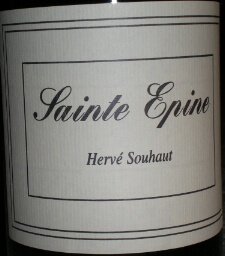
 2009 Hervé Souhaut Sainte Epine Saint-Joseph

Hervé Souhaut Sainte Epine 2009

Rhone, Cote Rotie aktig. Parfymert blomsterduft. Floral og lett i munnen. Mangler litt struktur. Grei vin til kr. 300,- 88 poeng

Fra olemski.blogspot:
Hervé Souhaut selger denne vinen som en Vin de Table selv om vinmarken ligger innenfor Saint Joseph i Nord-Rhône. Vinstokkene er over 100 år gamle, og maserasjonen er lang og vinene tappes uten filtrering. Det som karakteriserer vinen er renhet, tydelighet og den er intens. Dufter rene bjørnebær med litt jod, den har en glatt tekstur med en tydelig mineralitet i ettersmaken som går i retning noe metallisk. Er ikke videre kompleks, men den begeistrer med sin skarpskårne minimalisme. Svært attraktiv.


Pinot Nero IGT 2009, Dalzocchio Elisabetta Rovereto

Kjølig, strukturert, konsentrert burgundersk stil. En "giving" og solid vin. En veldig bra "lurevin". 91 poeng. 
Located in the town of Rovereto, Trentino, in the foothills of the Dolomite Mountains, Elisabetta’s tiny estate, with only five hectare under vine, is devoted entirely to the production of Pinot Nero (Pinot Noir). Pinot Nero and Chardonnay were first planted by her father in 1979. The Chardonnay has since been removed and today a mere 760 cases of Pinot Nero are produced each year. Elisabetta’s first vintage was 1995 and viticulture has been biodynamic since 1999 and certified organic since 2001. The grapes are carefully selected in the vineyards, and harvested in 10 kilo crates. They are destemmed, not crushed, then transferred to oak vats. Vinification is in open oak vats, with spontaneous fermentation, respecting tradition. The grape bunches are partly de-stemmed and the only other operation is punching the cap. Maceration lasts 18-20 days. After fermentation the wine is aged in French oak barrels for 18 months, in their cellars dating from the end of the eighteenth century. The wine is released after an additional year in bottle.

label


Hermitage Farconnet 2007, J.L. Chave Selection

En lettere stil av Hermitage, bitter og små tanniner. Sør-Frankrike eller Provence ? Ikke noen klassisk Hermitage. Og ikke noe lagringsprosjekt. 88 poeng


torsdag 7. mars 2013

En veldig god og rimelig hvitvin fra Hirtzberger...


Vinmøte Are 28.2.13:

Puligny Montrachet 1cru Les Pucelles 2005

Strågul med innslag av toast og fat. Fet nese og fet munn. Vi var overseas på denne og gjettet Kistler ! Spearmint, kraftig og veldig aromatisk. Men den roer seg etter en halv time i glasset og blir ikke lenger en hvit burgund på steroider. I denne rekka fremdeles ganske uelegant med touch av brente fat og smør. Over 14% alkohol ? Men ikke antydning til oxidasjon og viser årgangens opulente stil. 91-94 poeng

Jancis Robinson; "very broad and engaging on the nose with its slightly toasty topnote. Round and glorious with a thoroughly satisfying texture – quite a mouthful. So clean. yet rich! This has real deoth and savour. At the end of the palate it shut down a little but all in all this was a very good showing indeed"

.

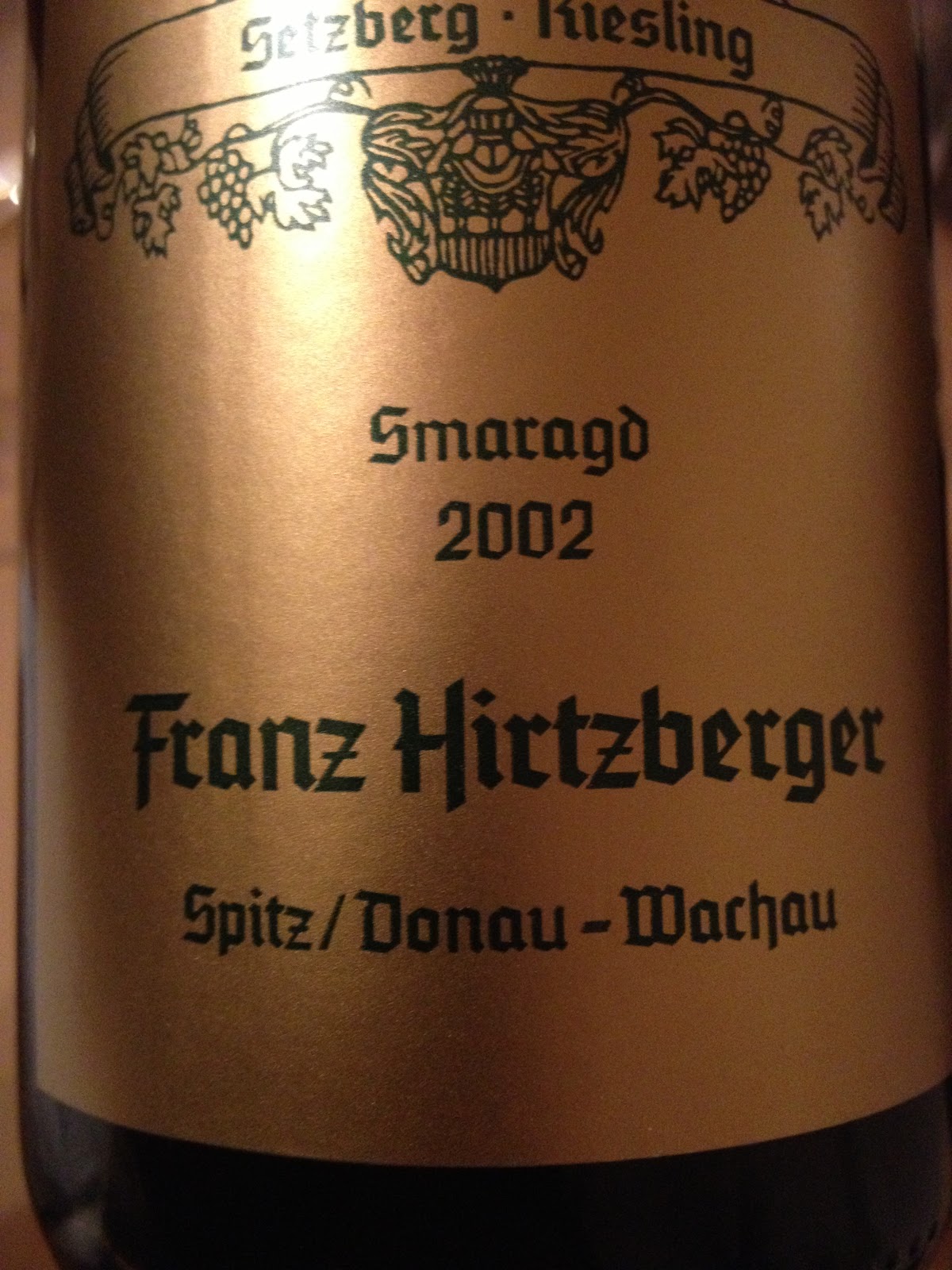
Riesling Smaragd 2002, Franz Hirtzberger

Litt elde på nesen, frisk og fin syre. Noe våte ullsokker, snev av gønnsak, Øyvind var på Grûner Veltliner. Skifer og petroleum etterhvert som ledet oss mot Riesling. Syra er fenomenal og det funker bra mot en viss fedme i vinen. Vi var i Alsace, Clos St. Hune og Leon Beyer. Enkelvinmark ? En klassevin til en rimelig penge. 92 poeng.

 
Karl Kristian Bjørnland sier dette om vinen; gullfarget, lys, klar. Stor, frisk og fruktig nese. Moden ananas, modne gule plommer, mineralitet og litt sødme. Stor munn, fyldig, frisk, fruktig, mineralsk, konsentrert, balansert, meget lang. Moden gul plomme, stålmineralitet, middels pluss syre tørrer pent. Frukten har nærmest mineraliteten som elegant og stor frakk. Den ligger der inne og viser seg frem, men beskyttes av stålet. Avslutningen kribler av frukt, spillende syre og mineralitet. Lenger enn jeg klarer å vente på neste munnfull. En nydelig vin. Fortsatt ungdommelig, men fylden og rikdommen gir så mye. Denne skulle jeg gjerne hatt en kasse av. Antagelig fantastisk til kraftige fiskeretter med rik og fet saus, grillet sjømat.


Meursault-Perrieres 2004, Matrot


Mere gylden, men en moderat og tilbakelent nese som ikke gir så mye til å begynne med. Etterhvert noe gassbind og medisinskap, og vi gikk mot Loire/Coulee de Serrant. Men var også innom hvit Bordeaux. Bra laget vin, korrekt, pen syre, men den har denne litt bitre ettersmaken med halspastill og gjærtoner. Særdeles mineralsk, finkornet sandstein. Som å tygge stein mente Are. Knut var på hvit burgund.  85-88 poeng 


Stephen Tanzer skriver; "Matrot characterizes his 2004s as a cross between 1999 and 2002: “Less solid and powerful than ’99, less nerveux but rounder and perhaps fatter than 2002.” He made the decision not to treat the vines against oidium, as he did not think it would be a bad idea to lose 15% to 20% of the crop in this copious year. The premier crus came in with potential alcohol in the 13.5% to 13.8% range and were not chaptalized. Matrot believes the 2004s wines will be easy to taste early on. As one of the family’s connected cellars is colder than the other, the malos here were only recently finished, or not quite done, and the wines kept here (Meursault, Chevaliers, Combettes and Perrieres) were a bit more difficult to taste this spring. Matrot told me he bottled his 2003s with less gas than the enologists advised, as he believes that carbonic gas has more of a negative effect when it combines with high alcohol (“it burns the wines”) than when it combines with acidity. He stirred the lees just twice in 2003, “so I could say that I did batonnage,” and he feels that the site character is beginning to emerge in a number of these wines. All of the 2003s were bottled by July of 2004.


Riesling Kirchenstûck GG 2010, Won Winning. Rheinpfalz

Lys og transparent, snev av eple, nyslått gress og solbærbusk. Loirevin fra Cotat ? Saltaktig munnfølelse, litt undermoden, floral, elegant, noe hul og spe munnfølelse. Enorm syre dominerer. Elegant vin som bør lagres. En produsent som Vinklubben har drukket lite av. Men til kr. 599,- skuffer den vel litt. En av de beste vinmarkene i Tyskland. 89-92 poeng

Dn.no. 88 poeng; duft av blomster og tropisk frukt. Bløt og fruktig med frisk syre. Den kjedeligste av vinene fra Kirchenstück. Drikk nå til 2022. Passer til sushi.


Meursault-Perrieres 2007, Matrot

Blank og lukket. Noe østers, litt kloakk, fin mineralitet, noe urent. Chablis ? Grønnere stil enn klassisk Meursault. Jordlig, litt "skallkontakt" i munnfølelsen. Rik, konsentrert og noe upresis. Men en vellykket vin. Og mere trøkk enn 2004 årgangen. 92-94 poeng.


onsdag 6. mars 2013

Champagne Jacques Lassaigne 2006


Vinmøte Are 28. februar 2013

Champagne Jacques Lassaigne 2006

Gjær i nesa, litt bitter, slank, enkel og kort. Vi var på Pinot Noir , men dette er Chardonnay ! Ingen sjarmør av en aperitif, selvom Are er imponert av produsenten. Et mindre champagnehus mente Kim. Skuffende for en cuveè fra produsenten. 84 poeng.


In the southernmost part of Champagne, the small family-run winery of Jacques Lassaigne is producing mineral-driven organic champagnes that are a noticeable departure from those of the more famous large houses headquartered in the northern part of the region.
Overseen today by Jacques’ son Emmanuel, the small winery sits perched atop a chalk hill in the town of Montgueux, with sweeping views of the valley stretching south to Chablis. Lassaigne owns 4.7 hectares of vineyards on the surrounding hills, with vines ranging from 35 to 55 years old, and also buys a small amount of grapes from a neighbor.
For Emmanuel, great champagne starts with making a good wine and that philosophy permeates every aspect of the winemaking process. Grapes are harvested only by hand and the yield is kept low. Once the grapes are harvested in mid-September, they are deposited into a press which dates back to 1957. Technology never interferes in the process, from the pressing to the use of gravity to move the juice through the floor, which itself acts as a filter of sorts and removes the need for filtration. To keep the personality of each vineyard, each parcel is vinified separately and then the wines are placed in barrels for 12 to 24 months. After being disgorged, the wines rest for an additional 4 to 6 months before going to market.


Lassaigne 1957 press lo.jpg

Lassaigne produces six cuvees, using mostly chardonnay with a small amount of pinot noir for his rosé. The house style is evident in each – minerality, citrus and exotic fruits. The Les Vignes de Montgueux, always a blend of two successive vintages of chardonnay from nine different plots, makes an excellent aperitif. The Rosé de Montgueux, made of 80% chardonnay and 20% pinot noir with no added sulfur, is fresh and fruity. Le Cotet is 100% chardonnay from the chalky single vineyard of the same name and delightfully fresh and vibrant. More complex with a richness derived from an older base is the La Colline Inspirée, a blend when tasted of barrel aged 2006 (80%) and 2000 (20%) vintages. Only available in magnums, this is truly an outstanding champagne.


Champagne Pol Roger Extra Cuvèe de Reserve 2002

Citrus og mere vinøs enn den første champisen. Et større champagnehus mente Kim. Mere dosage, eik, kremet, superb munnfølelse og ifølge de fleste en bedre truseknekker. Are var ikke enig.  Litt småkvalm i nesa. Klassisk, bra mousse og kan lagres ytterligere. 89 poeng
.